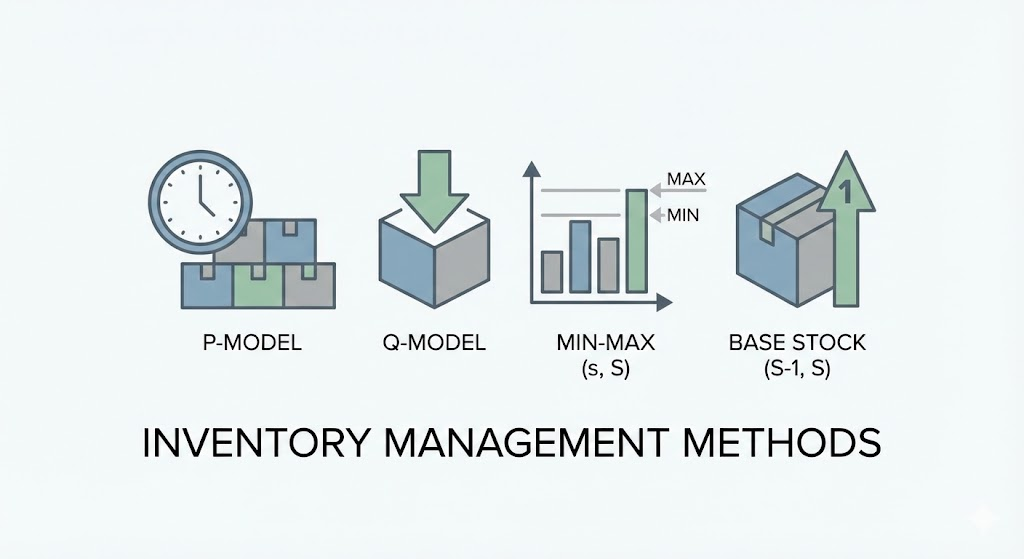

A. Classification using ABC Analysis
ABC Analysis is an inventory categorization technique based on the Pareto Principle (the 80/20 rule). it ranks inventory items based on their consumption value () over a specific period.
- Class A: Top 10-20% of items that account for 70-80% of total consumption value.
- Class B: Middle 30% of items that account for 15-20% of value.
- Class C: Bottom 50% of items that account for only 5% of value.
You cannot manage every item with the same level of intensity. Managing a $10,000 engine component (Class A) requires more oversight than a $0.50 bolt (Class C).
- Resource Allocation: ABC analysis tells you where to spend your “mental energy” and administrative time.
- Model Selection: Class A items usually require continuous review (Q-Model) to keep capital lean, while Class C items are better suited for periodic review (P-Model) or simple bulk ordering to save on shipping and paperwork.
How to do it?
- Calculate Annual Value: For every SKU, multiply the annual quantity used by the unit cost.
- Rank: Sort all items in descending order of their total annual value.
- Cumulative Percentage: Calculate the cumulative percentage of the number of items and the cumulative percentage of the total value.
- Categorize: Assign A, B, or C based on where the items fall on the cumulative value curve.
B. Inventory Control Methods
1. Q-Model
The Q-Model is a Continuous Review system. The inventory level is monitored constantly. The moment the stock drops to a predetermined Reorder Point (), a fixed quantity () (which is the ) is ordered. It is “event-triggered.”
Formula of this model
How much to order? Economic Order Quantity (), which balances ordering costs against holding costs:
- D = Annual Demand
- S = Setup/Ordering Cost
- H = Holding Cost per unit per year
When to order? Reorder Point ():
- d = average daily demand
- L = lead time in days
- SS = Safety Stock
When is it best to use?
Best for Class A items or high-value critical spares where you want to keep the average inventory as low as possible without stocking out.
2. P-Model
The P-Model is a Periodic Review system. Instead of watching stock constantly, you only check it at fixed time intervals (e.g., every Monday morning). You then order a variable amount to bring the stock back up to a “Target” level. It is “time-triggered.”
Formula of this model
Order Quantity ():
- d = average daily demand
- P = Review Period (days)
- L = Lead time (days)
- SS = Safety Stock
- I = Current Inventory level at the time of review
When is it best to use?
Best for Class B and C items, or when you want to consolidate orders from a single supplier to save on transport costs (e.g., ordering all General Service office supplies once a month).
3. Min Max Model (s, S)
This is a Hybrid System. Like the P-Model, it is reviewed periodically, but it includes a “Minimum” () threshold. If you check the stock and it is still above the Minimum, you do not order anything. You only trigger an order if the stock is , ordering enough to hit the Maximum ().
Formula of this model
If , then:
If , then:
When is it best to use?
Best for items with high ordering costs or items used in unpredictable bursts. It prevents the “small, frequent orders” that can happen in a pure P-Model, making it highly efficient for mining consumables like lubricants or filters.
4. Base Stock System (S-1, S)
The principal is One-for-One Replenishment. It maintains a fixed “Base” stock level (). The moment one unit is consumed, a replacement order for exactly one unit is triggered. There is no “Minimum” threshold other than .
Formula of this model
Whenever an item is pulled from the shelf, .
When is it best to use?
Best for extremely expensive, slow-moving, and critical items. In mining, this is for “Insurance Spares” like a spare transmission for a haul truck or a specialized hydraulic pump. You don’t want a “reorder point” because you can’t afford to have zero in stock—you always want that base level of 1 or 2 units ready.