Why Do We Need Different Volume Units?
In mining, especially in open-pit coal and metal mining, one of the most important activities is moving Overburden (OB) to expose the ore or coal underneath.
Since mining production is measured by the amount of material excavated and hauled, accurately calculating volume is essential for:
- Production planning
- Contractor payment
- Equipment productivity analysis
- Mine reconciliation
- Cost estimation
However, soil and rock do not maintain the same volume throughout the mining process.
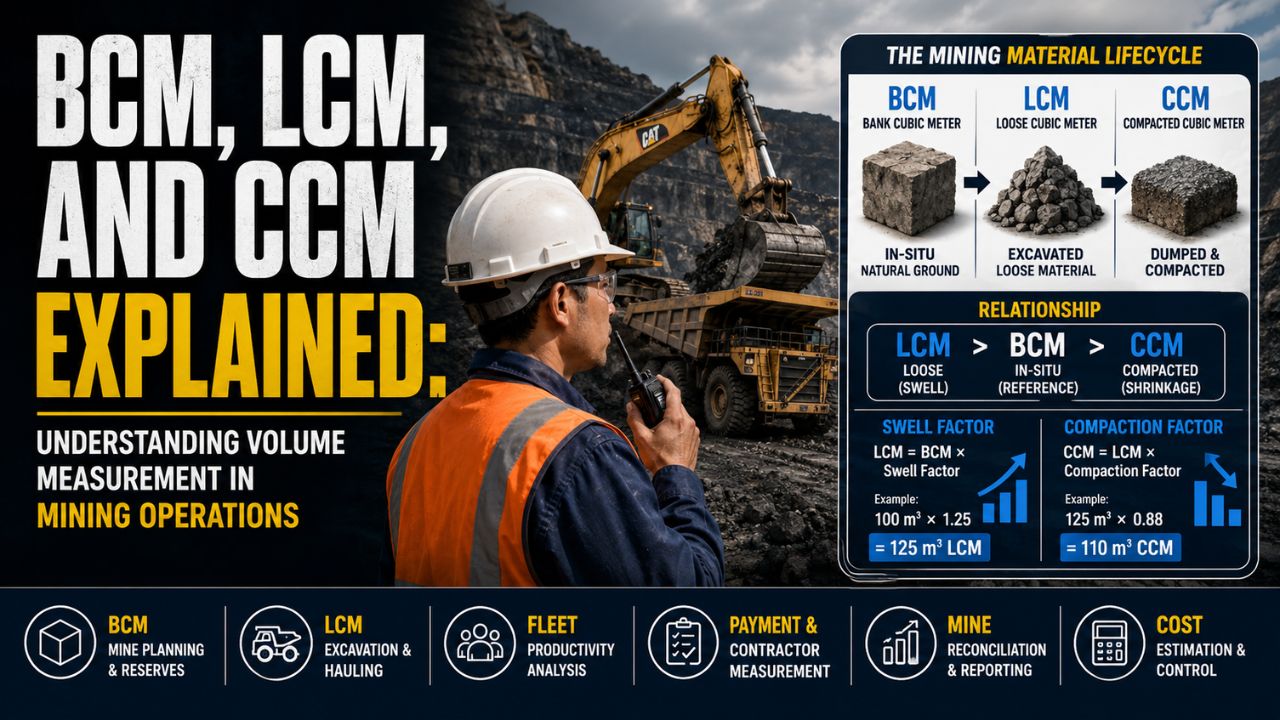
As material is excavated, hauled, and compacted, its volume changes. This is why the mining industry uses three different volume measurements:
- BCM (Bank Cubic Meter)
- LCM (Loose Cubic Meter)
- CCM (Compacted Cubic Meter)
The Mining Material Lifecycle
A single cubic meter of rock changes volume during its journey:
In-situ (Natural Ground)
↓ Excavated
Loose Material
↓ Dumped & Compacted
Compacted Material
Each stage represents a different physical condition of the material.
1. BCM (Bank Cubic Meter)
BCM is the volume of material before excavation, while it is still in its natural, undisturbed state. Also called:
- In-situ volume
- Bank volume
BCM is considered the reference volume because geological reserves and mine designs are based on the original ground.
Typical Uses
- Mine planning
- Reserve calculation
- Stripping Ratio (SR)
- Geological modeling
- Production targets
2. LCM (Loose Cubic Meter)
LCM is the volume after excavation, when the material becomes loose due to blasting, ripping, or digging. Because air spaces are introduced between particles, the volume increases. This increase is called Swell.
Typical Uses
- Truck payload estimation
- Excavator productivity
- Hauling operations
- Fleet management
3. CCM (Compacted Cubic Meter)
CCM is the volume after the loose material has been placed and compacted. Compaction removes some of the air voids created during excavation. CCM is commonly used for:
- Waste dumps
- Embankments
- Road construction
- Landfill
- Tailings facilities
Relationship Between BCM, LCM, and CCM
Generally,
BCM → Excavation → LCM → Compaction → CCM
In most cases:
LCM > BCM > CCM
because:
- Excavation causes swelling.
- Compaction reduces void spaces.
Swell Factor
Swell describes how much a material expands after excavation.
Formula:
Example:
BCM = 100 m³
Swell = 25%
LCM = 100 × 1.25
LCM = 125 m³
Meaning:
100 m³ of in-situ rock occupies 125 m³ after excavation.
Shrinkage (Compaction) Factor
Shrinkage describes how much loose material decreases in volume after compaction.
Formula:
Example:
LCM = 125 m³
Compaction Factor = 0.88
CCM = 125 × 0.88
CCM = 110 m³
Converting Between Units
BCM → LCM
LCM → BCM
LCM → CCM
CCM → LCM
Material Type Affects Volume Change
Different materials behave differently during excavation.
| Material | Typical Swell | Characteristics |
|---|---|---|
| Topsoil | 10–20% | Low expansion |
| Clay | 15–30% | Moderate swelling |
| Sand | 10–20% | Minimal volume change |
| Weathered Rock | 20–35% | Moderate expansion |
| Hard Rock (Blasted) | 40–70% | Significant swelling |
| Coal | 15–30% | Depends on fragmentation |
These values vary depending on moisture content, fragmentation, blasting quality, and material properties.
Why Does This Matter?
Using the wrong unit can lead to major errors.
For example:
A mine plan specifies: 1,000,000 BCM of overburden.
With a swell factor of 30%:
Actual hauling volume becomes: 1,300,000 LCM
If trucks are scheduled using BCM instead of LCM, the required truck fleet and hauling time will be underestimated.
Likewise, waste dump capacity must be designed using compacted volumes (CCM), not loose volumes (LCM).
Relationship with Stripping Ratio (SR)
Stripping Ratio (SR) is one of the most important KPIs in mining.
Formula:
Notice that overburden is almost always measured in BCM, because SR represents the original in-situ material to be removed before mining the ore or coal.
Practical Example
A mining block contains:
- Overburden = 10,000 BCM
- Swell Factor = 25%
- Compaction Factor = 0.90
Step 1
Calculate Loose Volume:
LCM = 10,000 × 1.25 = 12,500 LCM
Step 2
After dumping and compaction:
CCM = 12,500 × 0.90 = 11,250 CCM
Summary:
Original Ground: 10,000 BCM
After Excavation: 12,500 LCM
After Compaction: 11,250 CCM
Summary
- BCM measures material in its natural, undisturbed condition.
- LCM measures the increased volume after excavation due to swelling.
- CCM measures the reduced volume after compaction.
- Swell and compaction factors vary depending on the material type.
- BCM is primarily used for mine planning and Stripping Ratio calculations.
- LCM is used for excavation and hauling operations.
- CCM is used for dump construction, embankments, and earthworks.
- Understanding the relationship between BCM, LCM, and CCM is essential for accurate production reporting, equipment planning, and cost control in mining operations.